Caprifoliaceae › Abelia › 3 of 3

Abelia parvifolia Hemsl.
Also called Abelia macrotera var. parvifolia, Linnaea parvifolia.
| Family | Caprifoliaceae |
|---|---|
| Native to | China South-Central · Kew's World Checklist, file of 2026-06-04 |
| Your plants | Add one · related species |
Caprifoliaceae · China South-Central
Family Caprifoliaceae
Native to China South-Central
Summary
Abelia parvifolia is a species of flowering plant in the honeysuckle family, Caprifoliaceae. It is a shrub native to Hubei Province in central China.
Quoted from Wikipedia, "Abelia parvifolia", its opening paragraph, revision 1322130328, read 2026-11-08, CC BY-SA 4.0.
About the genus · Abelia
Abelia is a genus of flowering plants in the honeysuckle family, Caprifoliaceae. The genus currently includes six species native to China, Taiwan, and Vietnam.
Quoted from Wikipedia, "Abelia", its opening paragraph, revision 1368812582, read 2026-11-08, CC BY-SA 4.0.
Cultivation
Climate across the habitat
Natural habitat
This species has no GBIF key of its own. Its records are GBIF's under the key of the name Kew's World Checklist holds as this plant: 11147822 (Abelia macrotera var. parvifolia (Hemsl.) Landrein, 749 records). No name was matched to GBIF; the keys are read from Kew's synonymy. How.
Flowering by monthfrom few records: 0
No research-grade observation of a wild plant that iNaturalist shares with GBIF is annotated flowering under this page's GBIF keys, in GBIF's download.
Flowering observations of wild plants on iNaturalist, as iNaturalist shares them with GBIF: GBIF.org (2026-11-15) GBIF Occurrence Download https://doi.org/10.15468/dl.y8zpkp: 0 observations, research grade, openly licensed (CC0, CC BY or CC BY-NC), counted under the page's GBIF keys. Calendar months, as each plant was observed; not moved to your hemisphere.
How this section is made
Photograph
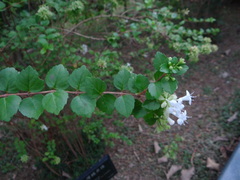
The photograph: Leonora (Ellie) Enking from East Preston, United Kingdom, CC BY-SA 2.0, via Wikimedia Commons. Credits as read from Wikimedia Commons on 2026-11-03. What each licence allows.
Related
Other Abelia 2 in the reference
 Abelia chinensis Chinese abelia Photo: CC BY, 呂一起(Lyu yi-chi)
Names & registers
Also known as Abelia macrotera var. parvifolia; Linnaea parvifolia. (WCVP, RBG Kew)
WFO Plant List (2026-06) a synonym of Linnaea parvifolia Graebn.. World Flora Online, CC0; read 2026-11-13.
Published in J. Linn. Soc., Bot. 23: 358 (1888) (WCVP, RBG Kew, file of 2026-06-04)
Elsewhere GBIF · Tropicos · Catalogue of Life · Flora of North America (identifiers from Wikidata's item Q10958064, read 2026-11-13, CC0)
Chromosomes no count in ChromoDB's IAPT/IOPB set (the file holds no count under IPNI id 148218-1). ChromoDB, IAPT/IOPB chromosome data (Simon, Bosch & Blanché), version 3.1 of 8 November 2026, CC BY 4.0; read 2026-11-13.
The record
Predicted extinction risk 42% probability of being threatened (95% interval 37% to 47%); predicted not threatened, low confidence: the interval crosses the model's threshold. A model's prediction, not an assessment. Bachman et al. 2024, New Phytologist; Kew's data of 1 February 2024, CC BY 4.0; read 2026-11-13.
CITES Not in the CITES Appendices (the edition in force from 5 March 2026): no listing of its name, its genus or its family. CITES Appendices I, II and III, valid from 5 March 2026; read 2026-11-13. The Appendices
Every figure here is derived from public data by a stated rule and names its source; nothing about this species is written for its page by a person or by AI, apart from the marked, credited quotations. How →
Where this page came from built 2026-11-18
kew.names answeredas of 2026-06-04Kew's entry Abelia parvifolia Hemsl. (plant_name_id 2609490), read from Kew's names filegbif.species not askedGBIF's backbone holds no one accepted species of this name, and a name it holds only as another species' synonym is not taken for this one, so GBIF's records were not asked (kept from this page's build of 2026-10-22)gbif.synonyms not askedGBIF's backbone holds no one accepted species of this name, and a name it holds only as another species' synonym is not taken for this one, so GBIF's records were not asked (kept from this page's build of 2026-10-22)gbif.vernacular not askedGBIF's backbone holds no one accepted species of this name, and a name it holds only as another species' synonym is not taken for this one, so GBIF's records were not asked (kept from this page's build of 2026-10-22)wcvp.distribution answeredas of 2026-06-04gbif.occurrences answeredas of 2026-10-21this species has no GBIF key of its own; its records are read under GBIF's keys for the names Kew's file holds as this plant, never by a name matched; GBIF occurrence download https://doi.org/10.15468/dl.hbdw64, of 2026-10-21; 749 records of GBIF's key 11147822, Abelia macrotera var. parvifolia (Hemsl.) Landrein (Kew's file holds it as Abelia macrotera var. parvifolia (Hemsl.) Landrein (synonym under Abelia parvifolia Hemsl.)): the GBIF download; records tested against the native regions' shapes, openly licensed and restricted alike (Natural Earth's provinces, placed in TDWG's regions; shapes rule r87); a record within the margin, off a coast or on an island too small to draw counted only when it states the region's country, and only on no other region's land but within 0.02° of a native shape across a border, where its stated state or province does not name the other region (read by Natural Earth's name, its ISO 3166-2 code or an old province's name); 2 records within 1 km of a botanic garden, herbarium or zoo left out (2 at a botanic garden or arboretum; Wikidata's list)climate nothing to reportasked 2026-11-18only 2 distinct land cells of the climate grid hold an in-range record placed to within 10 km; three are needed for an envelopewikidata answeredfound by Kew's IPNI identifier 148218-1, POWO 148218-1 (kept from this page's build of 2026-10-22)wikidata.names nothing to reportWikidata's item Q10958064; no English name taken (kept from this page's build of 2026-10-22)wikipedia answeredkept from this page's build of 2026-10-22; not asked againinat.taxon answerediNaturalist's taxon 367946 (Abelia parvifolia) is inactive; asked by name: iNaturalist's taxon 1477369 (Abelia parvifolia), found by its name (kept from this page's build of 2026-10-22)inat.photos.wild nothing to reportfrom iNaturalist's open data of 2026-09-27: research-grade observations with an open-licence photograph, the 24 whose photographs iNaturalist received last (the open data holds no votes); filled 2026-10-24 (kept from this page's build of 2026-10-22)inat.photos.cultivated nothing to reportobservations marked captive or cultivated whose identifications agree; filled 2026-10-24 (kept from this page's build of 2026-10-22)gbif.media not askedGBIF's backbone holds no one accepted species of this name, and a name it holds only as another species' synonym is not taken for this one, so GBIF's records were not asked (kept from this page's build of 2026-10-22)commons answeredkept from this page's build of 2026-10-22; not asked againopenalex not askedthe reference does not ask OpenAlex for papersEvery source is recorded as having answered, reported nothing, refused, failed, not been asked, or answered twice where one answer is taken (“not taken: two items answered”), and, for a source asked when this page was built, when: the figures are as the source held them that day; a source read from a file (Kew's World Checklist, a GBIF download) says "as of" the file's day instead; a row carried from an earlier build of the page names that build instead. Only “nothing to report” is ever shown as an absence. Records came from 11 datasets via GBIF.org; each carries its own licence.