Acacia argentina Pedley
| Family | Fabaceae |
|---|---|
| Native to | Queensland · Kew's World Checklist, file of 2026-06-04 |
| Your plants | Add one · related species |
Fabaceae · Queensland
Family Fabaceae
Native to Queensland
Summary
Acacia argentina is a species of flowering plant in the family Fabaceae and is endemic to Queensland. It is a shrub with greyish green to silvery blue, bipinnate leaves, yellow flowers arranged in racemes in leaf axils, and linear pods.
Quoted from Wikipedia, "Acacia argentina", its opening paragraph, revision 1297543251, read 2026-11-08, CC BY-SA 4.0.
About the genus · Acacia
Acacia, commonly known as wattles or acacias, is a genus of about 1,084 species of shrubs and trees in the subfamily Mimosoideae of the pea family Fabaceae. Initially, it comprised a group of plant species native to Africa, South America, and Australasia, but is now reserved for species mainly from Australia, with others from New Guinea, Southeast Asia, and the Indian Ocean.
Quoted from Wikipedia, "Acacia", its opening paragraph, revision 1381290315, read 2026-11-08, CC BY-SA 4.0.
Cultivation
Climate across the habitat
Natural habitat
Flowering by monthfrom few records: 0
No research-grade observation of a wild plant that iNaturalist shares with GBIF is annotated flowering under this page's GBIF keys, in GBIF's download.
Flowering observations of wild plants on iNaturalist, as iNaturalist shares them with GBIF: GBIF.org (2026-11-15) GBIF Occurrence Download https://doi.org/10.15468/dl.y8zpkp: 0 observations, research grade, openly licensed (CC0, CC BY or CC BY-NC), counted under the page's GBIF keys. Calendar months, as each plant was observed; not moved to your hemisphere.
How this section is made
Photographs
No openly licensed photograph on file. If you grow this plant, add your own photograph to your record.
Related
Other Acacia 180 in the reference
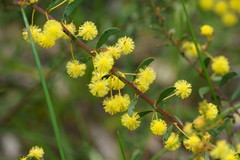 Acacia acinacea Gold-dust acacia Photo: CC BY, Kym Nicolson
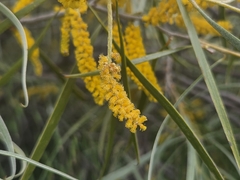 Acacia acuminata Jam wattle Photo: CC BY, Chantel McWilliam
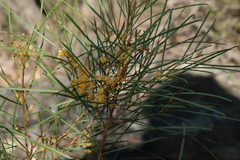 Acacia adunca Wallangarra wattle Photo: CC BY-SA, Greg Tasney
 Acacia alata Winged wattle Photo: CC BY-SA, Charles Stirton
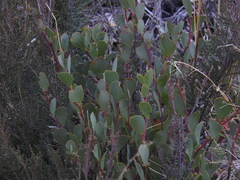 Acacia alpina Alpine Wattle Photo: CC BY, ttsquid
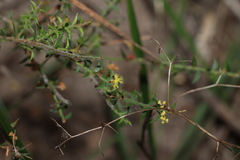 Acacia amblygona Fan Wattle Photo: CC BY-SA, Greg Tasney
 Acacia ammobia Mount Conner Wattle Photo: CC BY, Murray Fagg
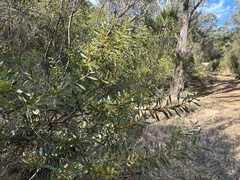 Acacia amoena Boomerang wattle Photo: CC BY, prossington
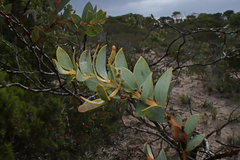 Acacia anceps Fabaceae Photo: CC0, Connor Margetts
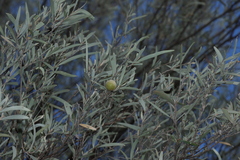 Acacia aneura Mulga Photo: CC BY-SA, Greg Tasney
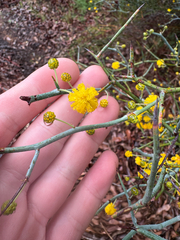 Acacia aphylla Leafless Rock Wattle Photo: CC BY, Tyler Anthony
 Acacia araneosa Balcanoona Wattle Photo: CC0, garrytre all 181 ›
Names & registers
WFO Plant List (2026-06) accepted. World Flora Online, CC0; read 2026-11-13.
Published in Austrobaileya 7: 348 (2006) (the page on BHL) (WCVP, RBG Kew, file of 2026-06-04; page by BHL’s resolver for this citation)
Elsewhere Tropicos · Catalogue of Life · Flora of Australia · APNI (identifiers from Wikidata's item Q15289392, read 2026-11-13, CC0)
Chromosomes no count in ChromoDB's IAPT/IOPB set (the file holds no count under IPNI id 77079723-1). ChromoDB, IAPT/IOPB chromosome data (Simon, Bosch & Blanché), version 3.1 of 8 November 2026, CC BY 4.0; read 2026-11-13.
The record
Predicted extinction risk 14% probability of being threatened (95% interval 9% to 19%); predicted not threatened, the model is confident of this class. A model's prediction, not an assessment. Bachman et al. 2024, New Phytologist; Kew's data of 1 February 2024, CC BY 4.0; read 2026-11-13.
CITES Not in the CITES Appendices (the edition in force from 5 March 2026): no listing of its name, its genus or its family. CITES Appendices I, II and III, valid from 5 March 2026; read 2026-11-13. The Appendices
Every figure here is derived from public data by a stated rule and names its source; nothing about this species is written for its page by a person or by AI, apart from the marked, credited quotations. How →
Where this page came from built 2026-11-18
gbif.species answeredkept from this page's build of 2026-11-01gbif.synonyms answeredkept from this page's build of 2026-11-01gbif.vernacular answeredasked 2026-11-18names fetched 2026-10-21; carried by an offline re-derivation of 2026-11-18wcvp.distribution answeredas of 2026-06-04gbif.occurrences answeredas of 2026-10-21GBIF occurrence download https://doi.org/10.15468/dl.hbdw64, of 2026-10-21; records tested against the native regions' shapes, openly licensed and restricted alike (Natural Earth's provinces, placed in TDWG's regions; shapes rule r87); a record within the margin, off a coast or on an island too small to draw counted only when it states the region's country, and only on no other region's land but within 0.02° of a native shape across a border, where its stated state or province does not name the other region (read by Natural Earth's name, its ISO 3166-2 code or an old province's name)climate nothing to reportasked 2026-11-18only 2 distinct land cells of the climate grid hold an in-range record placed to within 10 km; three are needed for an envelopewikidata answeredkept from this page's build of 2026-10-21wikipedia answeredkept from this page's build of 2026-10-21; not asked againinat.taxon answerediNaturalist's taxon 898630 (Acacia argentina), kept from an earlier build, checked 2026-10-23: active and this species' own (kept from this page's build of 2026-10-21)inat.photos.wild nothing to reportfrom iNaturalist's open data of 2026-09-27: research-grade observations with an open-licence photograph, the 24 whose photographs iNaturalist received last (the open data holds no votes); filled 2026-10-22 (kept from this page's build of 2026-10-21)inat.photos.cultivated nothing to reportobservations marked captive or cultivated whose identifications agree; filled 2026-10-24 (kept from this page's build of 2026-10-21)gbif.media nothing to reportas of 2026-10-21from the GBIF download https://doi.org/10.15468/dl.hbdw64, of 2026-10-21commons nothing to reportkept from this page's build of 2026-10-21openalex not askedthe reference does not ask OpenAlex for papersEvery source is recorded as having answered, reported nothing, refused, failed, not been asked, or answered twice where one answer is taken (“not taken: two items answered”), and, for a source asked when this page was built, when: the figures are as the source held them that day; a source read from a file (Kew's World Checklist, a GBIF download) says "as of" the file's day instead; a row carried from an earlier build of the page names that build instead. Only “nothing to report” is ever shown as an absence. Records came from 4 datasets via GBIF.org; each carries its own licence.