Acanthaceae › Acanthus › 11 of 14
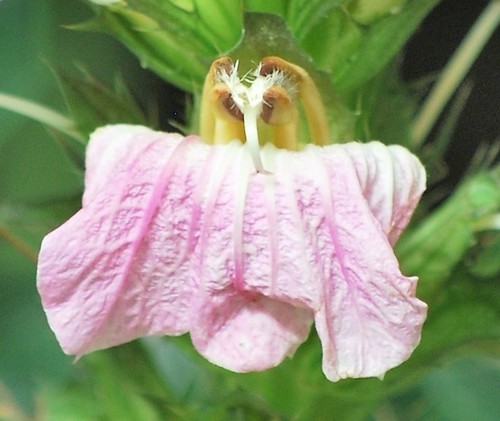
Acanthus montanus (Nees) T.Anderson
Mountain thistle; Bear's breech
Also called Acanthus barteri, Cheilopsis montana.
| Family | Acanthaceae |
|---|---|
| Native to | Benin, Nigeria, Sierra Leone, Burundi, Central African Republic, Cameroon, Congo, Gabon, Gulf of Guinea Is., Rwanda, Zaïre, Chad, Angola, Zambia · Kew's World Checklist, file of 2026-06-04 |
| Your plants | Add one · related species |
Acanthaceae · Benin +13
Also called Bear's breech
Family Acanthaceae
Native to Benin, Nigeria, Sierra Leone, Burundi, Central African Republic, Cameroon, Congo, Gabon, Gulf of Guinea Is., Rwanda, Zaïre, Chad, Angola, Zambia
Habitat in shortFigures ›
- Cold floor
- 16.3 °C 1 night in 100 colder NASA POWER
- Rain
- 2,569 mm a year, median across the range CHELSA
- Open-sky light
- 23–34 DLI lowest to highest month CHELSA
- Season
- Rainy season May–Oct, the habitat's months; even warmth CHELSA
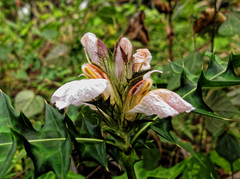
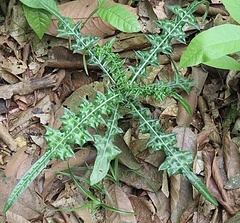
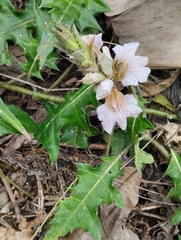


 34 photographs ›
At a glance
- Jan
- Feb
- Mar
- Apr
- May, shaded
- Jun, shaded
- Jul, shaded
- Aug, shaded
- Sep, shaded
- Oct, shaded
- Nov
- Dec
Hardiness of the habitat
| USDA zone of the habitat | 13a | the mean of the typical spot’s lowest night in each of 44 complete years, 1981–2024: 15.9 °C = 15.9 × 9 ÷ 5 + 32 = 60.62 °F, in zone 13a (60 to 65 °F). USDA’s zones are the 30-year mean of each year’s lowest temperature, in 10 °F zones with 5 °F half-zones (USDA Plant Hardiness Zone Map); this mean is of the years the series holds, not USDA’s 1991–2020. |
|---|---|---|
| RHS band of the record low | H1b | the record low falls in RHS’s H1b band (10 to 15 °C: heated glasshouse, subtropical; RHS hardiness rating): 13.1 °C, the lowest night in 44 years. |
Both are the habitat’s, worked out from where it grows wild: neither is a tested hardiness of the plant. Lows from NASA POWER (MERRA-2) daily 1981–2024, cell 5.00_6.875, lapse-corrected -15 m at 6.5 °C/km.
Climate class
Am Köppen–Geiger, worked out from the median year of the range’s 60 cells
| A tropical | the coldest month 24.5 °C, 18 °C or more; not arid: 2486 mm a year, 10 × 51.8 mm (2 × 25.9: 74% of the rain in winter, 70% or more) or more |
|---|---|
| m monsoon | the driest month 29 mm, under 60 mm but at least 100 − 2486 mm ÷ 25 = 0.6 mm |
By the thresholds of Peel, Finlayson and McMahon (2007), Hydrology and Earth System Sciences 11, 1633–1644, Table 1; summer is the warmer of October to March and April to September. The class of the median year, each month’s median across the cells, not of each cell.
Walter–Lieth: arid in December to January, where the month’s rain in mm is under twice its mean temperature in °C (January 29 mm against 2 × 26.6 = 53.2). The scale of Walter and Lieth’s climate diagrams (1960–1967), 10 °C to 20 mm.
The months read: CHELSA V2.1 1981–2010 climatology, 0.05° cells (each the mean of ~36 1 km pixels).
At home, aim for (worked out from the figures above)
| Winter nights | 15–23 °C | the July mean nightly low, 10th to 90th percentile across the 60 cells of the range, median 22.2 °C (CHELSA V2.1, 1981–2010); its coldest night on record was 13.1 °C (NASA POWER, daily lows over 44 years at the typical spot) |
|---|---|---|
| Summer days | 27–34 °C | the February mean daily high, 10th to 90th percentile across the 60 cells of the range, median 31.8 °C (CHELSA V2.1, 1981–2010) |
| Grow light, 14 h a day | 562 µmol/m²/s | the year’s mean daily light, 28.3 mol/m²/day (the twelve monthly medians averaged; open sky, CHELSA V2.1, 1981–2010 solar radiation at 2.07 mol of PAR per MJ), × 1,000,000 ÷ (14 × 3,600) |
| Humidity | 64–70% | the lowest and highest of the twelve monthly median relative humidities (CHELSA V2.1, 1981–2010); a figure about the air, saying nothing of how the plant takes water |
A starting point worked out from where it grows wild, not tested in cultivation. The light is the open sky’s; a plant among rocks or shrubs gets less.
Summary
Acanthus montanus, also known as bear's breech or mountain thistle and in Igbo; ogwu_agamevu (in Agbani, Enugu State Nigeria) is a species of flowering plant in the genus Acanthus. It is native to tropical Africa, growing in wet and shady places like stream borders in Sierra Leone in West Africa and from Benin to Chad, Zambia, and Angola in central Africa.
Quoted from Wikipedia, "Acanthus montanus", its opening paragraph, revision 1378436680, read 2026-11-08, CC BY-SA 4.0.
Cultivation
Seasons
The rain rule reads a sharp season: 70% of the median year's rain (1,933 mm of 2,486 mm) falls in May to October. The temperature curve is flat, 2.8 °C between the warmest and coldest month, so the growing-season rule does not infer a growing season from it. Months are the habitat's, northern hemisphere. The habitat lies within 10° of the equator, where the shift rule does not apply, so they are not shifted for a collection elsewhere.
Rain
2,486 mm in the median year at the habitat, 1,933 mm of it May to October. Wettest month July at 379 mm, driest months (2 at 29 mm). Across the grid cells of the range the year's total runs 1,480 mm to 2,946 mm, the 10th to 90th percentile of each cell's own year. The median of the cells' own yearly totals, 2,569 mm, is the year's rain at the top of the page; the 2,486 mm here is the median year's, the twelve monthly medians added, which the rain rule reads. Habitat calendar, northern hemisphere; median year across the grid cells of the range, CHELSA.
Light
Open sky over the habitat: 23 to 34 mol/m²/day across the year (daily light integral, median year across the grid cells of the range, CHELSA; the lowest 10th-percentile month across the cells is 22, the highest 90th-percentile month 37).
Warmth and air
Coldest: the 1st-percentile night over 44 years at a typical spot in the range is 16.3 °C, the absolute minimum 13.1 °C, no frost in 44 years (NASA POWER daily minima). Warmest: the 99th-percentile day is 33.2 °C. Monthly means: the coldest month's mean nightly low 22.2 °C in July and August (across the grid cells of the range 14.9 °C to 23.0 °C), the warmest month's mean daily high 31.8 °C in February (median year across the grid cells of the range, CHELSA). Cold floor: 16.3 °C, which is the 1st-percentile night over 44 years at a typical spot in the range (NASA POWER).
Relative humidity at the habitat: 64 to 70% across the year (monthly means, median year across the grid cells of the range, CHELSA). A figure about the air, saying nothing about how the plant takes water.
How this section is made
Each card states this species' habitat figures with their sources, and what two fixed rules read from them; nothing here says what the plant does, wants or tolerates. The rules · the terms.
Seasons. Read from the median year of CHELSA monthly rainfall and mean temperature across the grid cells of the range: the rain rule takes the smallest set of months carrying 70% of the rain and calls it winter when its mean is more than half a degree below the year's, summer when more than that above, and neither in between; the temperature rule, used only under 120 mm, names the cooler six months when they are at least a degree cooler than the other six. Months are shifted for the other hemisphere only where the temperature curve moves 4 °C or more and the habitat lies 10° or more from the equator. A reading of the curves, not an observation of the plant.
Rain. CHELSA monthly precipitation, median year across the grid cells of the range. The rain that falls where the species is recorded; nothing about how the plant takes water.
Light. CHELSA shortwave radiation at each envelope cell, a daily-mean flux taken to a daily total and converted at 2.07 mol of PAR per MJ. The sky over the habitat, measured; what reaches a plant under a rock, a shrub or a shade cloth is not.
Temperature. NASA POWER daily minima and maxima over 44 years at a typical spot in the range, lapse-corrected -15 m to its elevation; CHELSA monthly means, median year across the grid cells of the range. The cold floor is the 1st-percentile night named in its sentence. Not a measured survival limit for any plant in a pot.
Humidity. CHELSA relative humidity, median year across the grid cells of the range.
Climate across the habitat
Habitat months, northern hemisphere
Mean daily high from 27 °C in Jul and Aug to 32 °C in Feb; mean nightly low from 22 °C in Jul, Aug and Sep to 24 °C in Mar and Apr. The cold quarter, Jul to Sep, is the three months around the coldest month's mean nightly low, centred on the 3 months in a row that tie for it. 2,486 mm of rain in the median year (the twelve monthly medians added), the wettest month Jul. The bands show the 10th to 90th percentile across 60 habitat cells. Over 44 years at a typical spot in the range (NASA POWER) the absolute minimum was 13.1 °C and the 1-in-100 hot day (the 99th-percentile day) 33.2 °C; neither is dated to a month. Beneath: daily light integral and relative humidity through the year, each on its own scale.
Figures by month
| Month | Day °C | Night °C | Rain mm | DLI | RH % |
|---|---|---|---|---|---|
| Jan | 31 / 26–33 | 23 / 18–24 | 29 / 10–170 | 33 / 32–36 | 64 / 54–69 |
| Feb | 32 / 27–34 | 23 / 19–25 | 55 / 31–181 | 34 / 33–37 | 64 / 56–68 |
| Mar | 31 / 27–33 | 24 / 19–25 | 129 / 85–223 | 32 / 31–35 | 66 / 62–69 |
| Apr | 31 / 26–32 | 24 / 20–25 | 198 / 151–291 | 30 / 29–34 | 67 / 66–70 |
| May | 30 / 26–30 | 23 / 19–25 | 265 / 122–294 | 28 / 27–33 | 68 / 65–71 |
| Jun | 28 / 25–29 | 23 / 16–24 | 316 / 11–357 | 24 / 23–32 | 69 / 63–72 |
| Jul | 27 / 25–28 | 22 / 15–23 | 379 / 3–491 | 23 / 22–32 | 69 / 60–72 |
| Aug | 27 / 25–29 | 22 / 15–23 | 328 / 11–386 | 24 / 23–34 | 68 / 62–72 |
| Sep | 28 / 26–29 | 22 / 16–24 | 350 / 62–477 | 25 / 24–34 | 69 / 66–73 |
| Oct | 29 / 25–29 | 23 / 18–24 | 295 / 170–384 | 27 / 25–32 | 70 / 67–72 |
| Nov | 30 / 25–31 | 23 / 19–24 | 113 / 37–375 | 29 / 29–33 | 67 / 65–72 |
| Dec | 31 / 25–32 | 23 / 18–24 | 29 / 11–228 | 31 / 31–34 | 65 / 58–70 |
How this section is made
Natural habitat
Flowering by monthfrom few records: 8
- 1Jan
- 2Feb
- 0Mar
- 0Apr
- 1May
- 1Jun
- 1Jul
- 1Aug
- 1Sep
- 0Oct
- 0Nov
- 0Dec
Flowering observations of wild plants on iNaturalist, as iNaturalist shares them with GBIF: GBIF.org (2026-11-15) GBIF Occurrence Download https://doi.org/10.15468/dl.y8zpkp: 8 observations, research grade, openly licensed (CC0, CC BY or CC BY-NC), counted under the page's GBIF keys. Calendar months, as each plant was observed; not moved to your hemisphere.
From few records: 8 observations; a page says so under 12, and shows the counts as read.
How this section is made
Photographs
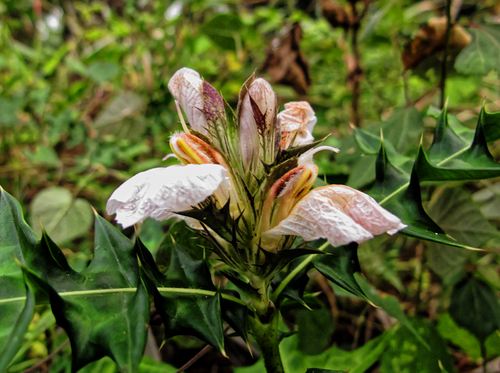

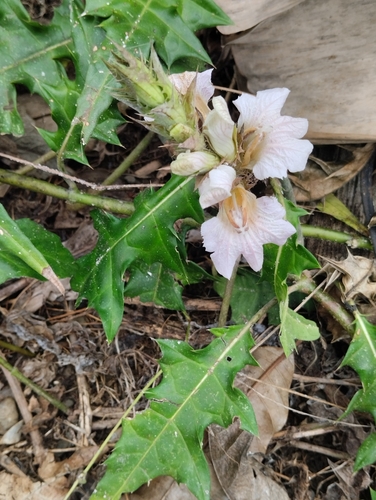
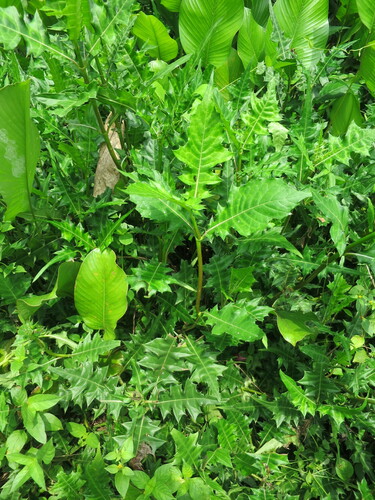
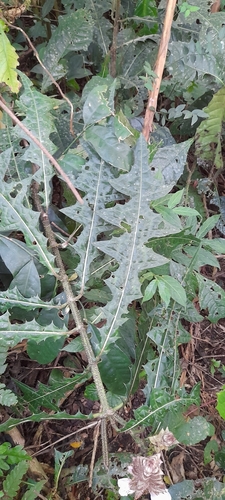

The photograph at the top: (c) Charles Stirton, some rights reserved (CC BY-SA), in cultivation, observed 2012-05-07. Photographs: (c) Philippe Hornus, some rights reserved (CC BY); Irene, no rights reserved (CC0); (c) David Pereira, some rights reserved (CC BY); Ricardo Lima, no rights reserved (CC0); (c) Mathew Rees, some rights reserved (CC BY); (c) Duarte Frade, some rights reserved (CC BY). Credits as read from iNaturalist on 2026-11-03. What each licence allows.
Related
Similar habitat climate The 6 nearest by mean daily high, mean nightly low and rain, month by month. How.
 Ficus barteri Moraceae Photo: CC BY-SA, Ji-Elle
 Raphia vinifera West African piassava palm Photo: Public domain, Toluaye
 Dracaena arborea Tree dracaena Photo: CC BY, Lucy Keith-Diagne
 Anubias barteri Araceae Photo: Public domain, en:User:Tsunamicarlos
 Lasimorpha senegalensis Swamp Arum Photo: CC BY, pavlaki1968
 Piper guineense Benin pepper Photo: CC BY, B. Phalan
Other Acanthus 13 in the reference
 Acanthus arboreus Acanthaceae Photo: CC BY-SA, Aboalfotooh Yemen WILD life
 Acanthus caroli-alexandri Acanthaceae Photo: CC BY, Kostas Zontanos
 Acanthus dioscoridis Acanthaceae Photo: CC BY-SA, Dûrzan Cîrano
 Acanthus ebracteatus Sea Holly Photo: CC BY, Ong Jyh Seng
 Acanthus eminens Acanthaceae Photo: CC BY, Elliot Kulakow
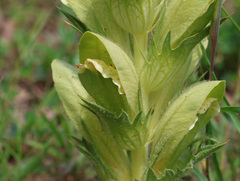 Acanthus hirsutus Syrian acanthus Photo: CC BY, Joey Bom
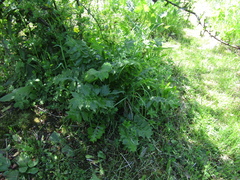 Acanthus hungaricus Hungarian Bear’s-Breeches Photo: CC BY, Oleksandr Shynder
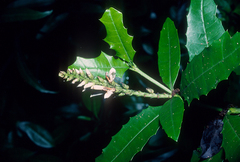 Acanthus ilicifolius Holly mangrove Photo: CC BY-SA, Douglas Goldman
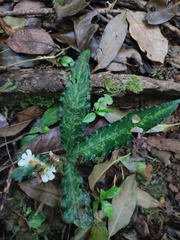 Acanthus leucostachyus Acanthaceae Photo: CC BY, Dmitry Ivanov
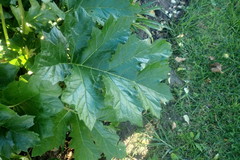 Acanthus mollis Bear's breech Photo: CC0, Di Turner
 Acanthus polystachyus Bear's Breeches Photo: CC BY-SA, M Kriek
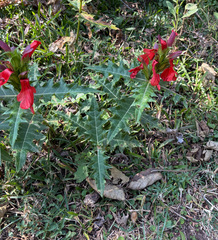 Acanthus sennii Ethiopian acanthus Photo: CC BY, avocat all 14 ›
Names & registers
Also known as Acanthus barteri; Cheilopsis montana. (GBIF Backbone)
WFO Plant List (2026-06) accepted. World Flora Online, CC0; read 2026-11-13.
Published in J. Proc. Linn. Soc., Bot. 7: 37 (1863) (WCVP, RBG Kew, file of 2026-06-04)
Elsewhere Tropicos · Catalogue of Life · IUCN Red List · Reflora · Missouri Plant Finder · NCBI (identifiers from Wikidata's item Q4672080, read 2026-11-13, CC0)
Chromosomes no count in ChromoDB's IAPT/IOPB set (the file holds no count under IPNI id 44894-1). ChromoDB, IAPT/IOPB chromosome data (Simon, Bosch & Blanché), version 3.1 of 8 November 2026, CC BY 4.0; read 2026-11-13.
The record
Predicted extinction risk 1% probability of being threatened (95% interval 1% to 2%); predicted not threatened, the model is confident of this class. A model's prediction, not an assessment. The IUCN Red List has assessed this species; its assessment comes before this prediction: its page at IUCN. Bachman et al. 2024, New Phytologist; Kew's data of 1 February 2024, CC BY 4.0; read 2026-11-13.
CITES Not in the CITES Appendices (the edition in force from 5 March 2026): no listing of its name, its genus or its family. CITES Appendices I, II and III, valid from 5 March 2026; read 2026-11-13. The Appendices
Every figure here is derived from public data by a stated rule and names its source; nothing about this species is written for its page by a person or by AI, apart from the marked, credited quotations. How →
Where this page came from built 2026-11-18
gbif.species answeredkept from this page's build of 2026-11-01gbif.synonyms answeredkept from this page's build of 2026-11-01gbif.vernacular answeredasked 2026-11-18names fetched 2026-10-21; carried by an offline re-derivation of 2026-11-18wcvp.distribution answeredas of 2026-06-04gbif.occurrences answeredas of 2026-10-21GBIF occurrence download https://doi.org/10.15468/dl.hbdw64, of 2026-10-21; records tested against the native regions' shapes, openly licensed and restricted alike (Natural Earth's provinces, placed in TDWG's regions; shapes rule r87); a record within the margin, off a coast or on an island too small to draw counted only when it states the region's country, and only on no other region's land but within 0.02° of a native shape across a border, where its stated state or province does not name the other region (read by Natural Earth's name, its ISO 3166-2 code or an old province's name); 34 records within 1 km of a botanic garden, herbarium or zoo left out (28 at a botanic garden or arboretum, 6 at a herbarium; Wikidata's list)climate answeredasked 2026-11-18climate.extremes answeredasked 2026-11-18NASA POWER (MERRA-2) daily 1981–2024, cell 5.00_6.875, lapse-corrected -15 m at 6.5 °C/kmwikidata answeredkept from this page's build of 2026-10-21wikipedia answeredkept from this page's build of 2026-10-21; asked again: skipped; the opening paragraph read again at revision 1378436680 of 2026-11-08, it differed (brackets)inat.taxon answerediNaturalist's taxon 188926 (Acanthus montanus), kept from an earlier build, checked 2026-10-23: active and this species' own (kept from this page's build of 2026-10-21)inat.photos.wild answeredasked 2026-10-24from iNaturalist's open data of 2026-09-27: research-grade observations with an open-licence photograph, the 24 whose photographs iNaturalist received last (the open data holds no votes); filled 2026-10-24; kept by the build of 2026-11-18 (this build: not asked: this build left iNaturalist to the daily fill, which asks for the photographs once the page's taxon is known)inat.photos.cultivated answeredasked 2026-10-24observations marked captive or cultivated whose identifications agree; filled 2026-10-24; kept by the build of 2026-11-18 (this build: not asked: this build left iNaturalist to the daily fill, which asks for the photographs once the page's taxon is known)gbif.media answeredas of 2026-10-21from the GBIF download https://doi.org/10.15468/dl.hbdw64, of 2026-10-21commons not askedkept from this page's build of 2026-10-28openalex not askedthe reference does not ask OpenAlex for papersEvery source is recorded as having answered, reported nothing, refused, failed, not been asked, or answered twice where one answer is taken (“not taken: two items answered”), and, for a source asked when this page was built, when: the figures are as the source held them that day; a source read from a file (Kew's World Checklist, a GBIF download) says "as of" the file's day instead; a row carried from an earlier build of the page names that build instead. Only “nothing to report” is ever shown as an absence. Records came from 44 datasets via GBIF.org; each carries its own licence.