Aspidistra
20 species in the reference · family Asparagaceae · 4 with a habitat climate · 20 grown, per iNaturalist
About the genus
Aspidistra is a genus of flowering plants in the family Asparagaceae, subfamily Convallarioideae, native to eastern and southeastern Asia, particularly China and Vietnam. They grow in shade under trees and shrubs. Their leaves arise more or less directly from ground level, where their flowers also appear. The number of species known has increased considerably from the 1980s onwards, with around 250 accepted as of October 2026. More on Wikipedia
Quoted from Wikipedia, "Aspidistra", its opening paragraph, revision 1380005676, read 2026-11-08, CC BY-SA 4.0.
Where Aspidistra is native
| China Southeast | 13 |
|---|---|
| China South-Central | 5 |
| Vietnam | 4 |
| Hainan | 2 |
| Taiwan | 2 |
| Japan | 1 |
| Thailand | 1 |
Species native to each region. A species counts in every region it is native to. Native ranges: Kew's World Checklist of Vascular Plants (Govaerts et al., CC BY 4.0), file of 4 June 2026.
20 species
Aspidistra
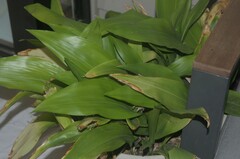 Aspidistra elatior Cast-iron-plant Photo: CC BY, Jon Sullivan
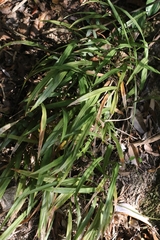 Aspidistra minutiflora Photo: CC0, Agnes Trekker
- no open photograph on file Aspidistra dolichanthera
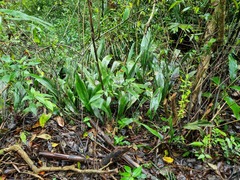 Aspidistra daibuensis Photo: CC BY, Cesar Ormazabal
- no open photograph on file Aspidistra hekouensis
- no open photograph on file Aspidistra linearifolia
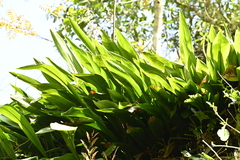 Aspidistra attenuata Photo: CC BY, 曾昱承 Yu-Cheng Zeng
 Aspidistra fungilliformis Photo: Public domain, Daderot
- no open photograph on file Aspidistra lurida
- no open photograph on file Aspidistra chunxiuensis
- no open photograph on file Aspidistra fimbriata
 Aspidistra grandiflora Photo: CC BY, scott.zona
- no open photograph on file Aspidistra ventricosa
- no open photograph on file Aspidistra hezhouensis
- no open photograph on file Aspidistra luodianensis
- no open photograph on file Aspidistra oblanceifolia
- no open photograph on file Aspidistra retusa
 Aspidistra subrotata Photo: Public domain, Daderot
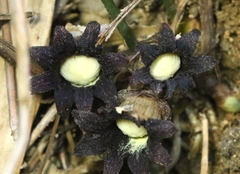 Aspidistra punctata Photo: CC0, Agnes Trekker
- no open photograph on file Aspidistra typica
Grown: iNaturalist's observations of the species marked captive or cultivated; "not counted" where the species list does not count it. Native ranges: Kew's World Checklist of Vascular Plants (Govaerts et al., CC BY 4.0), file of 4 June 2026. Grown: iNaturalist's observations marked captive or cultivated, counted 17 October 2026 (the species list's count). Habitat climate known: the species page has a habitat climate, read from CHELSA's monthly climate and NASA POWER's daily extremes at its well-placed wild records inside Kew's native range; each page says its own sources and days. Record low: the lowest night in NASA POWER's daily series at the habitat's typical spot, as the species page gives it, held in °C to a tenth and shown in your units; each page says its own years and day read. Counts as the reference built on 19 November 2026 holds them. The CSV holds every result, not only this page's.