Dierama
13 species in the reference · family Iridaceae · 10 with a habitat climate · 9 grown, per iNaturalist, 4 not counted
About the genus
Dierama is a genus of flowering plants in the family Iridaceae. Common names include hairbells, angel's fishing rod, fairybells, and wandflowers in English and grasklokkies (= grass-bells) in Afrikaans. They are native to Africa, with most occurring in the southern regions of the continent. The center of diversity is the province of KwaZulu-Natal in eastern South Africa.
Quoted from Wikipedia, "Dierama", its opening paragraph, revision 1292538973, read 2026-11-08, CC BY-SA 4.0.
Where Dierama is native
| Cape Provinces | 12 |
|---|---|
| KwaZulu-Natal | 10 |
| Lesotho | 3 |
| Free State | 2 |
| Northern Provinces | 1 |
| Zimbabwe | 1 |
Species native to each region. A species counts in every region it is native to. Native ranges: Kew's World Checklist of Vascular Plants (Govaerts et al., CC BY 4.0), file of 4 June 2026.
13 species
Dierama
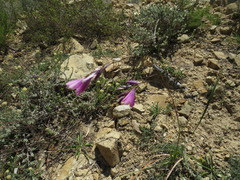 Dierama pulcherrimum Angel's Fishing Rod Photo: CC BY-SA, James Deacon
 Dierama pendulum Angel's-fishing-rods Photo: CC BY-SA, Nicola van Berkel
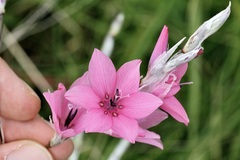 Dierama argyreum Ivory Hairbell Photo: CC BY, Dr. Alexey Yakovlev
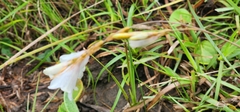 Dierama igneum Fairy Bell Photo: CC BY-SA, Suvarna Parbhoo Mohan
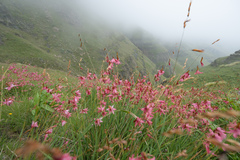 Dierama dracomontanum Photo: CC BY, Morten Ross
- no open photograph on file Dierama ambiguum
 Dierama pauciflorum Photo: CC BY-SA, Krzysztof Golik
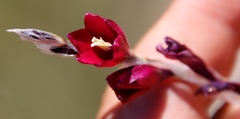 Dierama reynoldsii Photo: CC BY-SA, Tony Rebelo
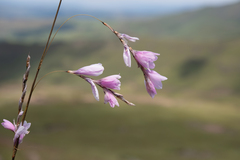 Dierama robustum Photo: CC BY, Morten Ross
- no open photograph on file Dierama dissimile
- no open photograph on file Dierama jucundum
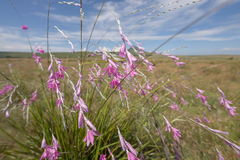 Dierama latifolium Broadleaf Hairbell Photo: CC BY, Morten Ross
 Dierama luteoalbidum Photo: CC BY, Alan Manson
Grown: iNaturalist's observations of the species marked captive or cultivated; "not counted" where the species list does not count it. Native ranges: Kew's World Checklist of Vascular Plants (Govaerts et al., CC BY 4.0), file of 4 June 2026. Grown: iNaturalist's observations marked captive or cultivated, counted 17 October 2026 (the species list's count). Habitat climate known: the species page has a habitat climate, read from CHELSA's monthly climate and NASA POWER's daily extremes at its well-placed wild records inside Kew's native range; each page says its own sources and days. Record low: the lowest night in NASA POWER's daily series at the habitat's typical spot, as the species page gives it, held in °C to a tenth and shown in your units; each page says its own years and day read. Counts as the reference built on 19 November 2026 holds them. The CSV holds every result, not only this page's.