Elatostema
7 species in the reference · family Urticaceae · 6 with a habitat climate · 6 grown, per iNaturalist, 1 not counted
About the genus
Elatostema is a genus of flowering plants containing approximately 350 known species in the nettle family Urticaceae, native to tropical forest clearings throughout Australasia, Asia and Africa. There may be as many as 1,000 species of this little-known genus, which is susceptible to deforestation and other forms of human exploitation. Some species, for instance the recently discovered E. fengshanense, show unusual adaptations to growing in deep shade in caves. DNA analysis suggests that the three genera Elastostema, Pellionia, and Pilea be grouped together as one.
Quoted from Wikipedia, "Elatostema", its opening paragraph, revision 1354873699, read 2026-11-08, CC BY-SA 4.0.
Where Elatostema is native
| China South-Central | 4 |
|---|---|
| China Southeast | 4 |
| Taiwan | 3 |
| Vietnam | 3 |
| Assam | 2 |
| East Himalaya | 2 |
| India | 2 |
| Japan | 2 |
| Korea | 2 |
| Laos | 2 |
| Myanmar | 2 |
| Nansei-shoto | 2 |
Species native to each region. A species counts in every region it is native to. Native ranges: Kew's World Checklist of Vascular Plants (Govaerts et al., CC BY 4.0), file of 4 June 2026.
7 species
Elatostema
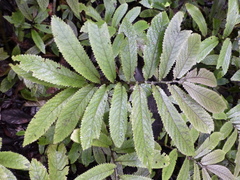 Elatostema rugosum Photo: CC BY, Murray NZ
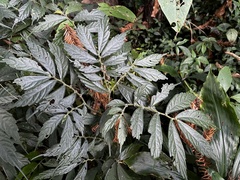 Elatostema lineolatum Large lineolate Elatostema Photo: CC BY, 黃美滿
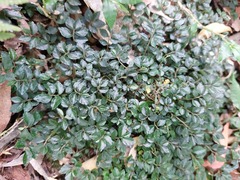 Elatostema radicans Photo: CC BY, 胡正恆(Jackson Hu)
 Elatostema reticulatum Rainforest Spinach Photo: CC BY, Peter Crowcroft
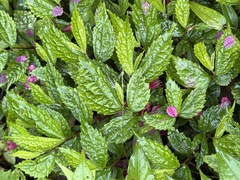 Elatostema cyrtandrifolium Photo: CC BY, 黃美滿
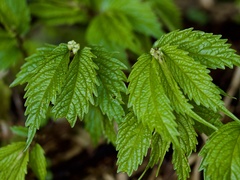 Elatostema involucratum Photo: CC BY, りなべる
 Elatostema sessile Photo: CC BY-SA, Yercaud-elango
Grown: iNaturalist's observations of the species marked captive or cultivated; "not counted" where the species list does not count it. Native ranges: Kew's World Checklist of Vascular Plants (Govaerts et al., CC BY 4.0), file of 4 June 2026. Grown: iNaturalist's observations marked captive or cultivated, counted 17 October 2026 (the species list's count). Habitat climate known: the species page has a habitat climate, read from CHELSA's monthly climate and NASA POWER's daily extremes at its well-placed wild records inside Kew's native range; each page says its own sources and days. Record low: the lowest night in NASA POWER's daily series at the habitat's typical spot, as the species page gives it, held in °C to a tenth and shown in your units; each page says its own years and day read. Counts as the reference built on 19 November 2026 holds them. The CSV holds every result, not only this page's.