Heliamphora
20 species in the reference · family Sarraceniaceae · 2 with a habitat climate · 5 grown, per iNaturalist, 15 not counted
About the genus
The genus Heliamphora ( or ; Greek: helos "marsh" and amphoreus "amphora") contains 24 species of pitcher plants endemic to South America. The species are collectively known as sun pitchers, based on the mistaken notion that the heli of Heliamphora is from the Greek helios, meaning "sun". The name instead derives from the Greek helos, meaning "marsh", so a more accurate translation of their scientific name would be marsh pitcher plants. Species in the genus Heliamphora are carnivorous plants that consist of a modified leaf form that is fused into a tubular shape. More on Wikipedia
Quoted from Wikipedia, "Heliamphora", its opening paragraph, revision 1384141835, read 2026-11-08, CC BY-SA 4.0.
Where Heliamphora is native
| Venezuela | 19 |
|---|---|
| Brazil North | 5 |
| Guyana | 1 |
Species native to each region. A species counts in every region it is native to. Native ranges: Kew's World Checklist of Vascular Plants (Govaerts et al., CC BY 4.0), file of 4 June 2026.
20 species
Heliamphora
 Heliamphora heterodoxa Photo: CC BY-SA, Paradise Chronicle
 Heliamphora minor Small marsh pitcher Photo: CC BY-SA, Daderot
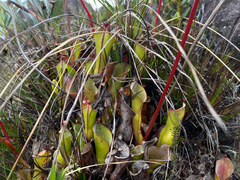 Heliamphora nutans Nodding marsh pitcher Photo: CC BY, topeuna
 Heliamphora ionasi Photo: CC BY-SA, Andreas Eils
 Heliamphora pulchella Photo: CC BY-SA, Andreas Eils
- no open photograph on file Heliamphora arenicola
- no open photograph on file Heliamphora ceracea Pico da Neblina marsh pitcher
 Heliamphora chimantensis Chimantá Massif marsh pitcher Photo: CC BY-SA, Seb38
- no open photograph on file Heliamphora collina
- no open photograph on file Heliamphora electrum
- no open photograph on file Heliamphora elongata
- no open photograph on file Heliamphora exappendiculata Chimantá-Aprada marsh pitcher
 Heliamphora folliculata Aparaman Tepui-group marsh pitcher Photo: CC BY-SA, Andreas Eils
- no open photograph on file Heliamphora glabra
- no open photograph on file Heliamphora hispida Cerro Neblina marsh pitcher
- no open photograph on file Heliamphora neblinae
- no open photograph on file Heliamphora parva Neblina Massif marsh pitcher
 Heliamphora purpurascens Purple Ptari Tepui marsh pitcher Photo: CC BY-SA, Seb38
- no open photograph on file Heliamphora sarracenioides Sarracenioid Ptari Tepui marsh pitcher
 Heliamphora tatei Giant marsh pitcher Photo: CC BY-SA, Petr Dlouhý
Grown: iNaturalist's observations of the species marked captive or cultivated; "not counted" where the species list does not count it. Native ranges: Kew's World Checklist of Vascular Plants (Govaerts et al., CC BY 4.0), file of 4 June 2026. Grown: iNaturalist's observations marked captive or cultivated, counted 17 October 2026 (the species list's count). Habitat climate known: the species page has a habitat climate, read from CHELSA's monthly climate and NASA POWER's daily extremes at its well-placed wild records inside Kew's native range; each page says its own sources and days. Record low: the lowest night in NASA POWER's daily series at the habitat's typical spot, as the species page gives it, held in °C to a tenth and shown in your units; each page says its own years and day read. Counts as the reference built on 19 November 2026 holds them. The CSV holds every result, not only this page's.