Phanera
14 species in the reference · family Fabaceae · 7 with a habitat climate · 14 grown, per iNaturalist
About the genus
Phanera is a genus of flowering plants in the legume subfamily Cercidoideae and the tribe Bauhinieae. This genus differs from Bauhinia in being vines or lianas, generally with tendrils and a lobed rather than spathaceous calyx, and from Schnella in having only three fertile stamens rather than ten, and being native to the Indomalayan realm and the Australasian realm rather than the Americas. The subsection Corymbosae was recently segregated into a new genus, Cheniella. It has been suggested that the genus Lasiobema should be reduced to a section within Phanera.
Quoted from Wikipedia, "Phanera", its opening paragraph, revision 1372944925, read 2026-11-08, CC BY-SA 4.0.
Where Phanera is native
| Thailand | 8 |
|---|---|
| China South-Central | 5 |
| Assam | 4 |
| East Himalaya | 4 |
| Malaya | 4 |
| Vietnam | 4 |
| Cambodia | 3 |
| Hainan | 3 |
| Laos | 3 |
| Sumatera | 3 |
| Bangladesh | 2 |
| China Southeast | 2 |
Species native to each region. A species counts in every region it is native to. Native ranges: Kew's World Checklist of Vascular Plants (Govaerts et al., CC BY 4.0), file of 4 June 2026.
14 species
Phanera
 Phanera kockiana Photo: CC BY-SA, Aiman Hakimi
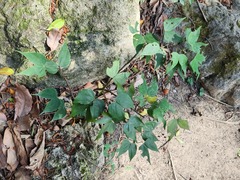 Phanera championii Champion's Bauhinia Photo: CC BY, 胡正恆(Jackson Hu)
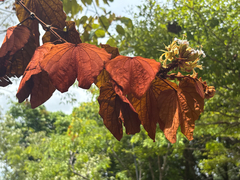 Phanera aureifolia Goldleaf Bauhinia Photo: CC BY-SA, athiwu
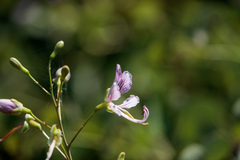 Phanera yunnanensis Phanera Photo: CC BY, Victor Engel
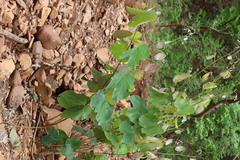 Phanera vahlii Photo: CC BY-SA, Vikas D Prasad
 Phanera bidentata Photo: CC BY, Cheongweei Gan
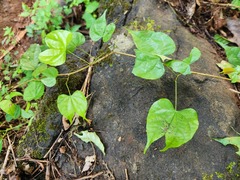 Phanera scandens Snake Climber Photo: CC BY-SA, deepachandran
- no open photograph on file Phanera strychnifolia
- no open photograph on file Phanera curtisii
 Phanera sirindhorniae Photo: CC BY-SA, 阿橋 HQ
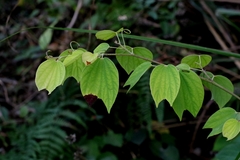 Phanera apertilobata Photo: CC0, Agnes Trekker
- no open photograph on file Phanera esquirolii
- no open photograph on file Phanera khasiana
- no open photograph on file Phanera siamensis
Grown: iNaturalist's observations of the species marked captive or cultivated; "not counted" where the species list does not count it. Native ranges: Kew's World Checklist of Vascular Plants (Govaerts et al., CC BY 4.0), file of 4 June 2026. Grown: iNaturalist's observations marked captive or cultivated, counted 17 October 2026 (the species list's count). Habitat climate known: the species page has a habitat climate, read from CHELSA's monthly climate and NASA POWER's daily extremes at its well-placed wild records inside Kew's native range; each page says its own sources and days. Record low: the lowest night in NASA POWER's daily series at the habitat's typical spot, as the species page gives it, held in °C to a tenth and shown in your units; each page says its own years and day read. Counts as the reference built on 19 November 2026 holds them. The CSV holds every result, not only this page's.