Swartzia
3 species in the reference · family Fabaceae · 3 with a habitat climate · 3 grown, per iNaturalist
About the genus
Swartzia is a genus of flowering plants in the family Fabaceae. It was named in honor of Swedish botanist Olof Swartz and contains about 200 species. Swartzia is restricted in its geographical distribution to the New World Tropics, where it occurs primarily in lowland rainforests, but also in savannas, pre-montane forests, and tropical dry forests. While it can be found throughout the wet lowlands from Mexico and the Caribbean islands to southern Brazil and Bolivia, Swartzia is most abundant and species-rich in Amazonia, where 10–20 species may co-occur at a single site. More on Wikipedia
Quoted from Wikipedia, "Swartzia", its opening paragraph, revision 1383168705, read 2026-11-08, CC BY-SA 4.0.
Where Swartzia is native
| Belize | 1 |
|---|---|
| Bolivia | 1 |
| Brazil North | 1 |
| Brazil West-Central | 1 |
| Colombia | 1 |
| Cuba | 1 |
| Guatemala | 1 |
| Honduras | 1 |
| Mexico Gulf | 1 |
| Mexico Southeast | 1 |
| Panama | 1 |
| Peru | 1 |
Species native to each region. A species counts in every region it is native to. Native ranges: Kew's World Checklist of Vascular Plants (Govaerts et al., CC BY 4.0), file of 4 June 2026.
3 species
Swartzia
 Swartzia jorori Photo: CC BY, Dick Culbert from Gibsons, B.C., Canada
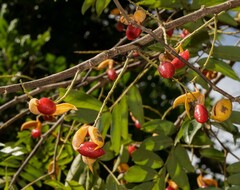 Swartzia cubensis Mexican royal ebony Photo: CC BY, Lon Brehmer
- no open photograph on file Swartzia robiniifolia
Grown: iNaturalist's observations of the species marked captive or cultivated; "not counted" where the species list does not count it. Native ranges: Kew's World Checklist of Vascular Plants (Govaerts et al., CC BY 4.0), file of 4 June 2026. Grown: iNaturalist's observations marked captive or cultivated, counted 17 October 2026 (the species list's count). Habitat climate known: the species page has a habitat climate, read from CHELSA's monthly climate and NASA POWER's daily extremes at its well-placed wild records inside Kew's native range; each page says its own sources and days. Record low: the lowest night in NASA POWER's daily series at the habitat's typical spot, as the species page gives it, held in °C to a tenth and shown in your units; each page says its own years and day read. Counts as the reference built on 19 November 2026 holds them. The CSV holds every result, not only this page's.