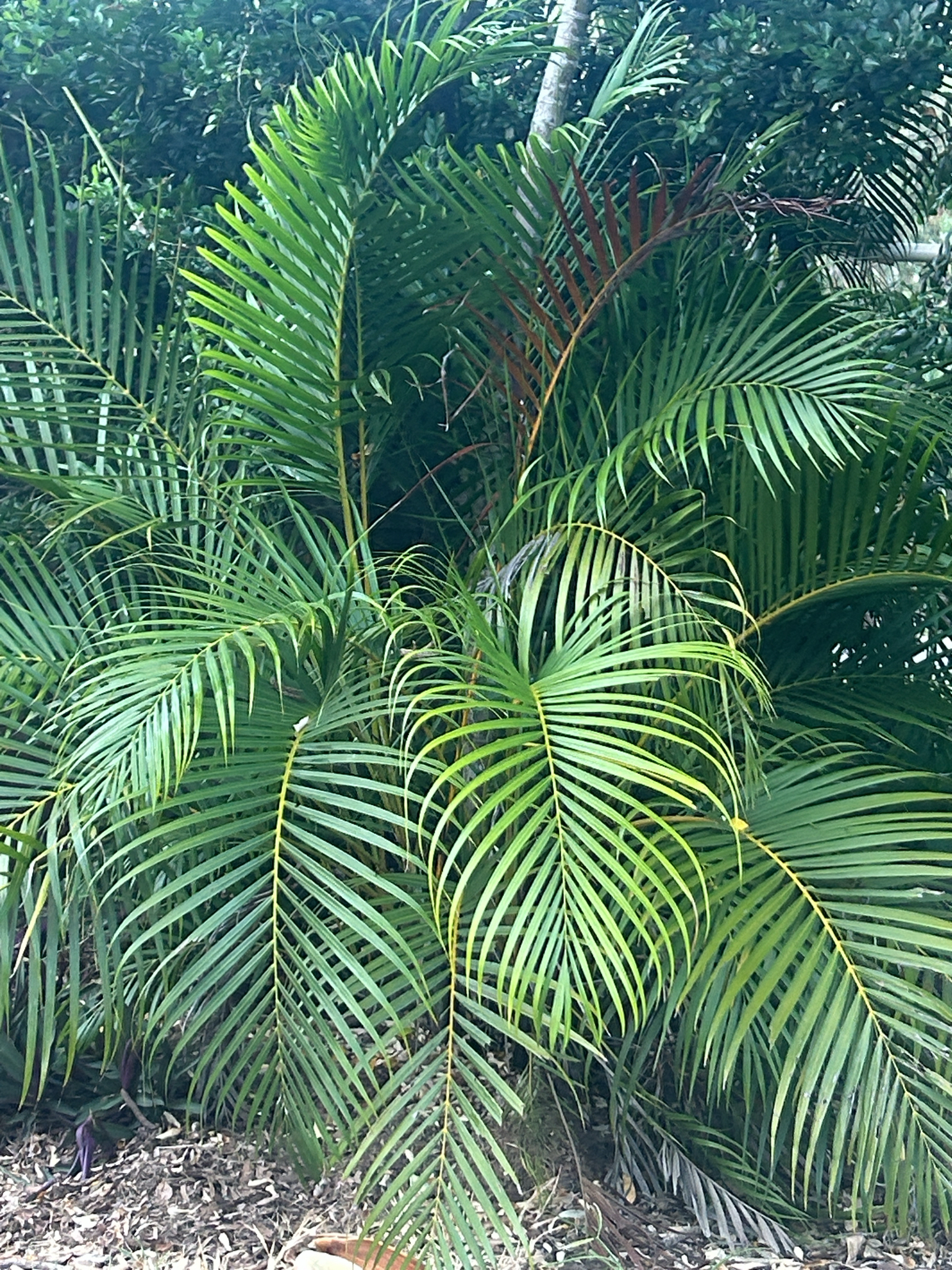
Species
+

Dypsis lutescens (H.Wendl.) Beentje & J.Dransf.

Areca palm, Sari mvovo, Sari popo, Yellow Butterfly Palm

No habitat climate 1 photograph Tropical foliage plant

Every figure on this page is derived from public data by a stated rule and says its source; nothing here is written by a person or a model, except the Wikipedia passage, which is quoted and marked as such. How it is made.

Summary

Chrysalidocarpus lutescens, also known by its synonym Dypsis lutescens and as golden cane palm, areca palm, yellow palm, butterfly palm, or bamboo palm, is a species of flowering plant in the family Arecaceae, native to Madagascar and naturalized in the Andaman Islands, Thailand, Vietnam, Réunion, El Salvador, Cuba, Puerto Rico, the Canary Islands, southern Florida, Haiti, the Dominican Republic, Jamaica, the Leeward Islands, and the Leeward Antilles. Its native names are rehazo and lafahazo.

Text from Wikipedia, “Chrysalidocarpus lutescens”, CC BY-SA 4.0, quoted as written. Kept separate from everything derived here.

About the genus · Dypsis

Dypsis is a genus of flowering plants in the family Arecaceae. They are slender, evergreen palms with yellow flowers carried in panicles amongst the pinnate leaves. Many Dypsis species have aerial branching, a rare growth habit among palms. More on Wikipedia ›

The opening of Wikipedia, “Dypsis”, CC BY-SA 4.0, quoted as written.

Family
Arecaceae
Described by
(H.Wendl.) Beentje & J.Dransf.
Native to
Madagascar
Wild records
15 in range· 2 open

At a glance

In short condensed by rule from the cultivation cards · not written by a person
Grouped as a tropical foliage plant by the genus Dypsis, which is reliably one kind of plant (archetype table); no habitat climate could be derived for this species. Cold floor 12 °C (conventional for a tropical foliage plant, archetype table).
Each sentence is one card's own one-line form, written by the same rule as the card (Temperature); the note cannot say what a card does not. The cards · the figures.

Also known as Areca flavescens Voss; Chrysalidocarpus baronii subsp. littoralis Jum. & H.Perrier; Chrysalidocarpus baronii var. littoralis Jum. & H.Perrier; Chrysalidocarpus glaucescens Waby; Chrysalidocarpus lutescens H.Wendl.

Cultivation

Grouped as a tropical foliage plant by the genus Dypsis, which is reliably one kind of plant (archetype table). The table supplies one figure for this group, a conventional minimum for the cold floor, and no prose.

Warmth and air Cold floor 12 °C (conventional for a tropical foliage plant, archetype table).

The archetype table’s figure; no habitat figure for this species.

Cold floor: 12 °C, the archetype table's conventional minimum for a tropical foliage plant (grouped by the genus Dypsis, which is reliably one kind of plant); no habitat figure is on file for this species.

The archetype table's conventional minimum for the group; no habitat figure is on file for this species.

The figures the cards read from are in Climate below, and where they came from in Natural habitat.

Climate across the habitat

No habitat climate can be derived: Only 2 distinct land cells of the climate grid hold an in-range record; three are needed for an envelope.

Natural habitat

Native range as published by WCVP; the marker is where the records are densest and decides nothing.
Openly licensed records inside the range, framed on where they fall.
NativeMadagascar· introduced: Comoros, Réunion, Assam, Bangladesh, Andaman Is., El Salvador, Dominican Republic, Haiti, Jamaica, Leeward Is. AB Ant, Puerto Rico, Trinidad-Tobago, Venezuelan Antilles
Kew's description“shrub or tree” · “wet tropical”· quoted from WCVP, RBG Kew (CC BY 4.0); not derived here
Map marker-18.75, 49.25 · in the densest population, 12 records (80% of those in range)
Evidence usedThe map marker rests on all 15 georeferenced records inside the native range; the map shows only the 2 openly licensed ones, which alone would put the marker 227 km away. 782 records outside the range (gardens, roadsides, misidentifications) ignored. No climate envelope is derived for this species. 13 in-range records are placed to worse than 10 km and stay on the map but off the climate.
The map markerthe map marker: the centre of the tenth-degree cell nearest the middle (no openly licensed record lies in the population, so no record's coordinates are published) of the densest 1° population of the 15 in-range records; it decides nothing.

Photographs: iNaturalist did not answer when this page was built; what is shown came from the sources that did.

Papers naming this species

Works whose title or abstract names Dypsis lutescens, most cited first, from OpenAlex (CC0). A mention, not a cultivation source: nothing on this page is drawn from them.

Assessing air pollution tolerance of plant species in vegetation traffic barriers in Kathmandu Valley, Nepal
Sunita Shrestha, Badri Baral, Narayan Babu Dhital, Hsi‐Hsien Yang (2021) · Sustainable Environment Research
Arrays of Plant Microbial Fuel Cells for Implementing Self-Sustainable Wireless Sensor Networks
Edith Osorio‐de‐la‐Rosa, Javier Vázquez‐Castillo, Alejandro Castillo-Atoche, Julio Heredia-Lozano (2020) · IEEE Sensors Journal
EVALUATION OF In-vitro ANTIBACTERIAL ACTIVITY AGAINST GRAM-NEGATIVE BACTERIA USING SILVER NANOPARTICLES SYNTHESIZED FROM Dypsis lutescens LEAF EXTRACT
T Akshaya, M R Aravind, S Manoj Kumar, Baskaran Divya (2022) · Journal of the Chilean Chemical Society
Effect of Four Growing Substrates on Growth of Ornamental Plants in Two Irrigation Systems
Kimberly A. Klock-Moore, Timothy K. Broschat (2001) · HortTechnology
Hepatoprotective activity of Dypsis lutescens against D-galactosamine-induced hepatotoxicity in rats and its phytoconstituents
WalaaA El-Kashak, MaiM El-Ghonemy, TahiaK Mohamed, EnayatA Omara (2019) · Asian Pacific Journal of Tropical Biomedicine
Effects of Fertilizer Type on Quality and Nutrient Content of Established Landscape Plants in Florida
Timothy K. Broschat, David R. Sandrock, Monica L. Elliott, Edward F. Gilman (2008) · HortTechnology
An Energy-Saving Data Statistics-Driven Management Technique for Bio-Powered Indoor Wireless Sensor Nodes
Alejandro Castillo-Atoche, Javier Vázquez‐Castillo, Edith Osorio‐de‐la‐Rosa, Julio Heredia-Lozano (2021) · IEEE Transactions on Instrumentation and Measurement
Chemical fertilization, organic fertilization and pyroligneous extract in the development of seedlings of areca bamboo palm (Dypsis lutescens)
Christina da Silva Wanderley, Ricardo Tadeu de Faria, Maurício Ursi Ventura (2012) · Acta Scientiarum Agronomy
Analyzing Preferred Indoor Ornamental Potted Plants for Their Air Pollution Tolerance Ability
Shivani Chauhan, Kumari Manisha, Bhavya Bhargava, Kishor Chandra Kandpal (2022) · Polish Journal of Environmental Studies
Root and Shoot Growth Responses to Phosphate Fertilization in Container-grown Plants
Timothy K. Broschat, Kimberly A. Klock-Moore (2000) · HortTechnology
Variación Temporal y Espacial de la Abundancia del Picudo Negro (Rynchophorus palmarumL., Coleoptera: Curculionidae) en Cultivos de Palmas Ornamentales del Centro de Veracruz, México
Ivonne Landero-Torres, Ehdibaldo Presa-Parra, María Elena Galindo-Tovar, Otto Raúl Leyva–Ovalle (2015) · Southwestern Entomologist

Other Dypsis 1 in the reference

History & registers

Where this page came from built 2026-09-20 · dossier v2 · node
gbif.species answeredcarried from build of 2026-09-20 (offline re-derivation; the backbone was not asked)
gbif.synonyms answeredcarried from build of 2026-09-20 (offline re-derivation; the backbone was not asked)
gbif.vernacular answeredcarried from build of 2026-09-20 (offline re-derivation; the backbone was not asked)
wcvp.distribution answered
gbif.occurrences answeredGBIF occurrence search API
climate nothing to report
wikidata answeredcarried from build of 2026-09-20 (rederive); that build: carried from build of 2026-09-19 (rederive); that build: carried from build of 2026-09-19 (rederive)
wikipedia answeredcarried from build of 2026-09-20; this build: skipped
inat.taxon not askedcarried from build of 2026-09-20 (rederive)
inat.photos.wild nothing to reportcarried from build of 2026-09-20 (rederive); that build: carried from build of 2026-09-19 (rederive); that build: filled 2026-09-20
inat.photos.cultivated nothing to reportcarried from build of 2026-09-20 (rederive); that build: carried from build of 2026-09-19 (rederive); that build: carried from build of 2026-09-19 (rederive)
commons nothing to reportcarried from build of 2026-09-20 (rederive); that build: carried from build of 2026-09-19 (rederive); that build: carried from build of 2026-09-19 (rederive)
gbif.media answeredcarried from build of 2026-09-20; this build: skipped
openalex answeredcarried from build of 2026-09-20; this build: skipped

Every upstream is recorded as having answered, reported nothing, or refused. Only “nothing to report” is ever shown as an absence. Records came from 12 datasets via GBIF.org; each carries its own licence.