Amorphophallus
43 species in the reference · family Araceae · 16 with a habitat climate · 33 grown, per iNaturalist, 10 not counted
About the genus
Amorphophallus is a large genus of some 200 tropical and subtropical tuberous herbaceous plants from the arum family (Araceae), native to Asia, Africa, Australia and various oceanic islands. The genus includes the Titan arum (A. titanum) of Indonesia, which has the largest inflorescence in the genus, and is known as the 'corpse flower' for the pungent odour it produces during its flowering period, which can take up to seven years of growth before it occurs.
Quoted from Wikipedia, "Amorphophallus", its opening paragraph, revision 1360519763, read 2026-11-08, CC BY-SA 4.0.
Where Amorphophallus is native
| Thailand | 20 |
|---|---|
| Laos | 7 |
| Vietnam | 7 |
| China South-Central | 6 |
| Malaya | 6 |
| China Southeast | 5 |
| Myanmar | 5 |
| Sumatera | 5 |
| Assam | 4 |
| Bangladesh | 4 |
| Borneo | 4 |
| Jawa | 4 |
Species native to each region. A species counts in every region it is native to. Native ranges: Kew's World Checklist of Vascular Plants (Govaerts et al., CC BY 4.0), file of 4 June 2026.
43 species
Amorphophallus
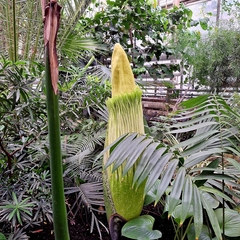 Amorphophallus titanum Corpse Flower Photo: CC0, Marek Hrušovský
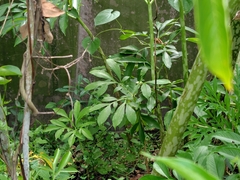 Amorphophallus paeoniifolius Elephant-yam Photo: CC BY, chiuluan
 Amorphophallus konjac Devil's tongue Photo: CC BY-SA, Sebastian Stabinger
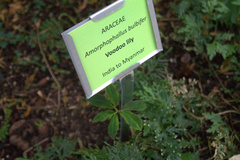 Amorphophallus bulbifer Photo: CC BY, Bryce
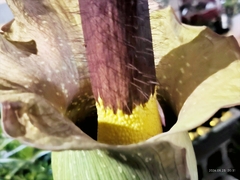 Amorphophallus hirtus Photo: CC BY, 四角銅鑼
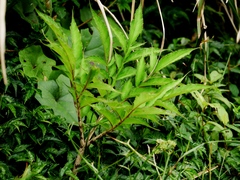 Amorphophallus kiusianus Photo: CC BY, Jacy Chen
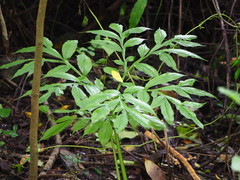 Amorphophallus henryi Photo: CC0, 葉子
 Amorphophallus gigas Corpse Flower Photo: CC BY-SA, Jon rambes
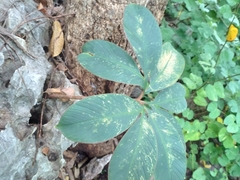 Amorphophallus atroviridis Photo: CC BY, Utain Pummarin
 Amorphophallus muelleri Photo: CC BY-SA, Rillke
- no open photograph on file Amorphophallus albus
 Amorphophallus decus-silvae Photo: CC BY-SA, Rudolphous
 Amorphophallus hewittii Photo: CC BY-SA, James K. Douch
- no open photograph on file Amorphophallus ongsakulii
 Amorphophallus variabilis Photo: CC BY, Ganjar Cahyadi
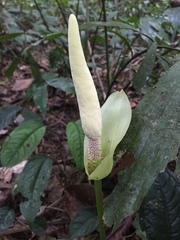 Amorphophallus coaetaneus Photo: CC BY-SA, Pavel Kirillov
 Amorphophallus dunnii Photo: CC BY-SA, Bijay Chaurasia
- no open photograph on file Amorphophallus amygdaloides
- no open photograph on file Amorphophallus borneensis
- no open photograph on file Amorphophallus haematospadix
- no open photograph on file Amorphophallus maxwellii
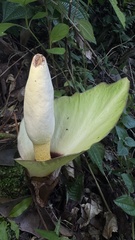 Amorphophallus prainii Photo: CC BY, Павлик Лисицын
 Amorphophallus yunnanensis Photo: CC BY-SA, 阿橋 HQ
- no open photograph on file Amorphophallus albispathus
- no open photograph on file Amorphophallus ankarana
- no open photograph on file Amorphophallus carneus
- no open photograph on file Amorphophallus cicatricifer
 Amorphophallus excentricus Photo: CC BY, Averater
 Amorphophallus flotoi Photo: CC BY-SA, Pawel Ryszawa
- no open photograph on file Amorphophallus fuscus
- no open photograph on file Amorphophallus impressus
- no open photograph on file Amorphophallus krausei
 Amorphophallus mossambicensis Photo: CC0, Nicholas Case WIghtman
- no open photograph on file Amorphophallus asterostigmatus
 Amorphophallus consimilis Photo: CC0, Sara L Giles
- no open photograph on file Amorphophallus fallax
- no open photograph on file Amorphophallus longituberosus
- no open photograph on file Amorphophallus lunatus
 Amorphophallus myosuroides Photo: CC BY, Enzo^
- no open photograph on file Amorphophallus ochroleucus
- no open photograph on file Amorphophallus sumawongii
- no open photograph on file Amorphophallus taurostigma
- no open photograph on file Amorphophallus thaiensis
Grown: iNaturalist's observations of the species marked captive or cultivated; "not counted" where the species list does not count it. Native ranges: Kew's World Checklist of Vascular Plants (Govaerts et al., CC BY 4.0), file of 4 June 2026. Grown: iNaturalist's observations marked captive or cultivated, counted 17 October 2026 (the species list's count). Habitat climate known: the species page has a habitat climate, read from CHELSA's monthly climate and NASA POWER's daily extremes at its well-placed wild records inside Kew's native range; each page says its own sources and days. Record low: the lowest night in NASA POWER's daily series at the habitat's typical spot, as the species page gives it, held in °C to a tenth and shown in your units; each page says its own years and day read. Counts as the reference built on 19 November 2026 holds them. The CSV holds every result, not only this page's.