Araucaria
19 species in the reference · family Araucariaceae · 12 with a habitat climate · 18 grown, per iNaturalist, 1 not counted
About the genus
Araucaria (original pronunciation: [a.ɾawˈka. ɾja]) is a genus of evergreen coniferous trees in the family Araucariaceae. While today they are largely confined to the Southern Hemisphere, during the Jurassic and Cretaceous they were globally distributed. There are 20 extant species in New Caledonia (where 14 species are endemic, see New Caledonian Araucaria), eastern Australia (including Norfolk Island), New Guinea, Argentina, Brazil, Chile and Uruguay.
Quoted from Wikipedia, "Araucaria", its opening paragraph, revision 1380991048, read 2026-11-08, CC BY-SA 4.0.
Where Araucaria is native
| New Caledonia | 13 |
|---|---|
| New Guinea | 2 |
| Queensland | 2 |
| Argentina Northeast | 1 |
| Argentina South | 1 |
| Brazil South | 1 |
| Brazil Southeast | 1 |
| Chile Central | 1 |
| Chile South | 1 |
| New South Wales | 1 |
| Norfolk Is. | 1 |
| Paraguay | 1 |
Species native to each region. A species counts in every region it is native to. Native ranges: Kew's World Checklist of Vascular Plants (Govaerts et al., CC BY 4.0), file of 4 June 2026.
19 species
Araucaria
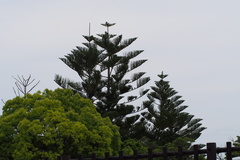 Araucaria heterophylla Norfolk Island pine Photo: CC BY-SA, harum.koh
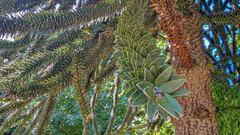 Araucaria araucana Monkey-puzzle Photo: CC BY, Julien Lepage
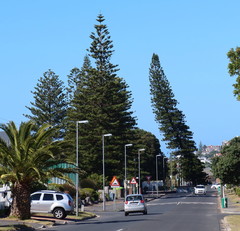 Araucaria columnaris New Caledonia pine Photo: CC BY, Diana Studer
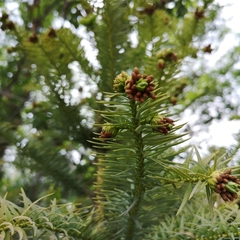 Araucaria bidwillii Bunya bunya Photo: CC BY-SA, Alejandro Arguelles
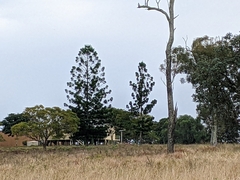 Araucaria cunninghamii Moreton Bay pine Photo: CC0, Beth Addison-smith
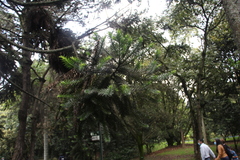 Araucaria angustifolia Parana-pine Photo: CC BY, Andrés Ramírez-Barrera
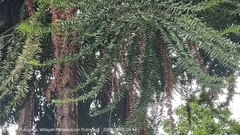 Araucaria hunsteinii Klinki pine Photo: CC BY-SA, Ong Jyh Seng
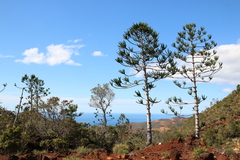 Araucaria rulei Rule's Araucaria Photo: CC0, Philip Precey
 Araucaria luxurians Coast araucaria Photo: CC BY-SA, Liné1
 Araucaria laubenfelsii Photo: CC BY-SA, J. MAlone
 Araucaria montana Mountain araucaria Photo: CC BY-SA, Liné1
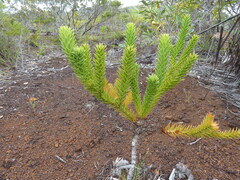 Araucaria muelleri Mueller's araucaria Photo: CC BY, Alain Le Magueresse
 Araucaria scopulorum Rock araucaria Photo: CC BY-SA, Jean.claude
 Araucaria subulata Narrow-leaf araucaria Photo: Public domain, Jebulon
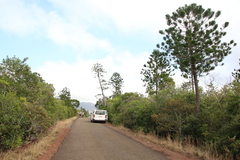 Araucaria nemorosa Boise araucaria Photo: CC0, Philip Precey
 Araucaria bernieri Bernier's araucaria Photo: CC BY, Thomas CUELHO from Bordeaux, France
 Araucaria biramulata Biramule araucaria Photo: CC BY-SA, Batsv
 Araucaria humboldtensis Humboldt's araucaria Photo: CC BY-SA, Nicolas Anger
- no open photograph on file Araucaria schmidii Mt Panie Araucaria
Grown: iNaturalist's observations of the species marked captive or cultivated; "not counted" where the species list does not count it. Native ranges: Kew's World Checklist of Vascular Plants (Govaerts et al., CC BY 4.0), file of 4 June 2026. Grown: iNaturalist's observations marked captive or cultivated, counted 17 October 2026 (the species list's count). Habitat climate known: the species page has a habitat climate, read from CHELSA's monthly climate and NASA POWER's daily extremes at its well-placed wild records inside Kew's native range; each page says its own sources and days. Record low: the lowest night in NASA POWER's daily series at the habitat's typical spot, as the species page gives it, held in °C to a tenth and shown in your units; each page says its own years and day read. Counts as the reference built on 19 November 2026 holds them. The CSV holds every result, not only this page's.